
AI Agent
Authorization
Independent human-presence evidence for high-consequence actions delegated to AI agents.
An AI agent can act in your name.
The harder question is whether you authorized it.
Responsibility for an agent’s action falls back on whoever delegated the authority. The log shows what the agent did — not that a real, authorized person stood behind it.
Transaction Executed
Funds moved by the agent on someone’s behalf.
Permissions Changed
Access granted or modified by the agent.
Workflow Released
A process started that affects the real world.
Stolen Session or Account
The agent runs on credentials someone else now controls.
Unauthorized Delegation
An agent is given authority no one actually approved.
Repudiated Approval
“It wasn’t me who authorized it” — and nothing on record answers that.
Two different proofs.
Used together.
Digital authorization and physical-presence evidence answer different questions. METAiD is not a replacement for either — it is the second one.
| Digital authorization e.g. FIDO2, SSO, signed approval | METAiD presence evidence | |
|---|---|---|
| What it establishes | An authenticator completed a cryptographic approval. | A real human was physically at a known point when the delegation was granted. |
| Where it is produced | On the authenticator and in the identity provider. | At the reader, on the relying party’s own side. |
| What it cannot show | Who was holding the authenticator. | The cryptographic chain — which is why both are kept. |
| Against repudiation | The key was used. | The person was there. |
Presence alone is not enough. The authorization must define what the agent is allowed to do.
Who authorized it
The enrolled person, verified at the reader.
What the agent may do
The specific actions the delegation covers.
When it is valid
The delegation expires when the window closes.
Physical Presence Attestation
Subject, scope and window bound to one presence event.

Not every AI action needs the same
level of human authorization.
The organization sets the tiers. The agent may reason, but the decision authority stays with whoever delegated it.
Autonomous
Routine, low-consequence actions run under the delegator’s own login.
Remote Approval
Digital approval through existing authentication.
Physical Approval
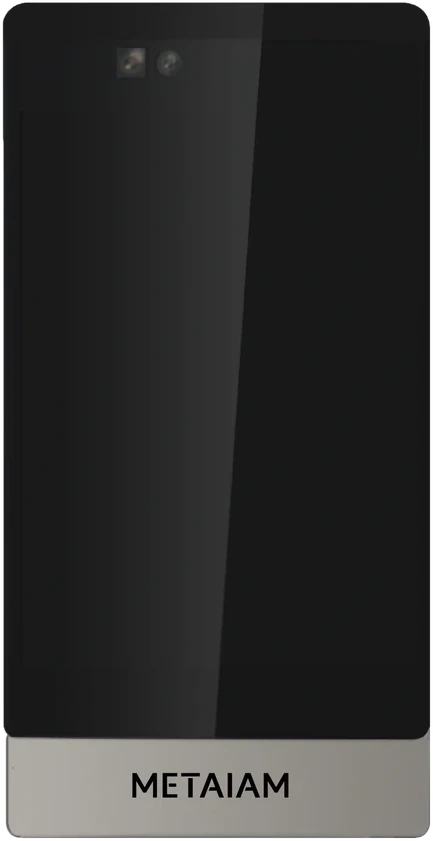
METAiD proves the authorized person is physically at the reader.
Field-Limited Approval
Physical presence, and the authorization is limited to a defined physical area.
Levels 3 and 4 are where METAiD adds physical-presence evidence.
Works with your
AI and IAM systems.
Existing agent platforms and identity systems stay. METAiD adds evidence they cannot produce on their own.
- RequestAn agent requests a high-consequence action in your enterprise or AI system.
- FlagYour authorization policy places the action at Level 3 or Level 4.
- AttestThe authorized person verifies at a METAiD reader, and the scope and valid window are bound to that presence event.
- ReleaseThe delegation is released to the agent, with the attestation attached and recorded.
No change to the agent. The attestation is produced beside your existing flow and reaches it through the Enterprise API. Your identity provider, policy engine and agent platform are untouched.
What a deployment looks like.
A reader wherever a high-consequence delegation is granted, and an API into the system that grants it.
What the attestation
actually carries.
Bound to a person, not an account
The evidence is created at the reader, independent of the credential the agent runs on.
Scope that travels with it
The delegation names the actions it covers. Anything outside that scope is not authorized by it.
A window that closes by itself
The authorization expires when the window ends, with nothing left to revoke.
Two approvers, not one
Require several authorized people present together, including a required combination of roles, before a delegation is granted.
Limited to a physical area
At Level 4, the authorization only holds for actions tied to a defined location.
An answer to repudiation
The record shows a real person was present when the authority was granted.
Why it holds up.
The authorized person.
Accountability lands on a person who was there, not on an account that was open.
Not forgeable.
A depth sensor measures physical space. An AI model can generate an image; it cannot produce a body — which is the whole point when the thing being authorized is an AI.
Data that is safe to hold.
No RGB camera in the hardware, so no color photograph is ever produced. What is enrolled is not linked to a legal identity, and has no practical use anywhere else if it is taken.
Where it applies.
Agent actions whose consequences land in the physical world, or on someone else’s money.
| Agent action | The gap today | Industries |
|---|---|---|
| Moving money | A transfer executes in seconds under a delegated credential, with nothing showing who granted that authority. | |
| Changing operational settings | A setting change can interrupt service or affect safety, and the approval trail stops at a session. | |
| Granting or widening access | An agent that can change permissions can change its own, and the log records the change, not the mandate. | |
| Starting a physical process | Once the process begins it is expensive or impossible to take back, yet it started from a digital approval alone. |
Built by a team with a track record of over 1 billion access events across more than 5,000 mission-critical sites. METAIAM is an OSPA finalist.
AI can execute the action.A human stays accountable for it.