
In-Person
Authorization
Presence verification for high-value actions.
Remote approval is convenient.
For high-value actions, it is no longer enough.
Every remote factor proves an approval arrived from the account. None of them proves the account holder was the one who sent it.
Phone Approval
Approves from whichever device currently holds the account.
OTP / PIN
Codes can be phished, intercepted, or talked out of someone.
Remote Biometric
A face or voice check over a camera arrives as an image or a stream.
Account Takeover
The attacker approves from the victim’s own account, through the normal flow.
Coercion & Social Engineering
The real holder approves, but not of their own accord.
AI-Assisted Impersonation
Synthetic faces and voices are produced to order.
Not every action deserves
the same proof.
Keep remote approval where it belongs. Raise the bar only where the consequence justifies it.
| Action tier | How it is approved today | What METAiD adds |
|---|---|---|
| RoutineEveryday, low-consequence | Session login. | Nothing. This tier runs exactly as it does today. |
| ElevatedReversible, moderate value | Password, push approval, OTP. | Nothing by default. Available if your policy wants it here. |
| High-valueHard to reverse, high consequence | The same remote factors, carrying a much larger action. | Evidence that the authorized person was physically at a controlled point before the action is released. |
Your policy decides which actions sit in the top tier. METAiD only enters the flow for those, so the convenience of everyday approval is untouched.
Works with your
authorization workflow.
Your business systems and risk rules stay. METAiD adds a presence step when policy calls for one.
- RequestA high-value action is initiated in your business system.
- FlagYour authorization policy marks it as in-person required.
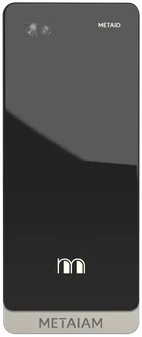
- ProveThe authorized person verifies at a METAiD reader at a controlled location — a branch, a counter, an office.
- ReleaseThe action is released, with the presence record attached to it.
No new branch build-out. A reader goes where the person already comes — a counter, a kiosk, a back-office door. It runs on existing wiring and power, and reaches your systems through the Enterprise API.
What a deployment looks like.
A reader at each location where high-value actions are released, and an API into the system that releases them.
Rules the authorization
policy can actually hold.
Required only where you set it
Presence is demanded for the actions your policy marks high-value, and nowhere else.
Evidence independent of the account
The presence record is created at the reader, separate from the credential that started the request.
Two people, not one
Require several authorized people present together, including a required combination of roles — for approvals that should never rest on one person.
A window that closes by itself
An authorization can be bound to a schedule or a shift and expire without anyone revoking it.
Presentation-attack resistance
Resists masks, replicas and 3D displays, not only photographs.
Released into your flow
The decision reaches your business system in real time through Webhooks, MQTT, WebSocket or REST.
Why it holds up.
The authorized person.
The action is released because that person was there — not because their account was used.
Not forgeable.
A depth sensor measures physical space. An AI model can generate an image; it cannot produce a body.
Data that is safe to hold.
No RGB camera in the hardware, so no color photograph of a customer or an employee is ever produced. What is enrolled is not linked to a legal identity, and has no practical use anywhere else if it is taken.
Where it applies.
Actions where a remote approval is not proportionate to what happens next.
| Action | The gap today | Industries |
|---|---|---|
| High-value transfers & withdrawals | The largest movements use the same approval factors as a routine balance check. | |
| Account recovery & profile changes | Resetting the factors is the attack. The approval that authorizes it is made with the factors being replaced. | |
| Operational changes on live systems | A change that can interrupt service is released from a session, with no evidence of who was at the site. | |
| Controlled clinical & donation actions | A signature or a login stands in for the clinician or donor who had to be there. | |
| Cash handling & high-limit floors | Access and authorization are separate systems, so nothing ties the release to the person who was standing there. |
Built by a team with a track record of over 1 billion access events across more than 5,000 mission-critical sites. METAIAM is an OSPA finalist.
Approve remotely when you can.Require presence when it matters.