
AI-Resistant
Physical Verification
Defending physical systems against AI-driven impersonation.
AI can imitate a person.
Physical systems need more than appearance.
Anything a system decides from an image can be answered with an image. Generating that image used to be hard. It is getting easier every quarter.
Is a real enrolled person physically here?

Verify physical reality,
not digital appearance.
An image check asks whether something looks right. A depth measurement asks whether something is there.
| What is presented | Why it can satisfy an image check | What a depth measurement establishes |
|---|---|---|
| A photograph | It carries the same visible features the check is looking for. | A flat surface. No human volume in the space. |
| A screen or video replay | Motion and blinking answer the usual liveness cues. | A plane at a fixed distance, not a body. |
| A mask or physical replica | It is built to reproduce the visible surface. | Presentation-attack resistance evaluates the structure, not the surface. |
| An AI-generated likeness | It is produced from the same distribution the check was trained on. | Inferred depth is not measured depth. The model has nothing to measure. |
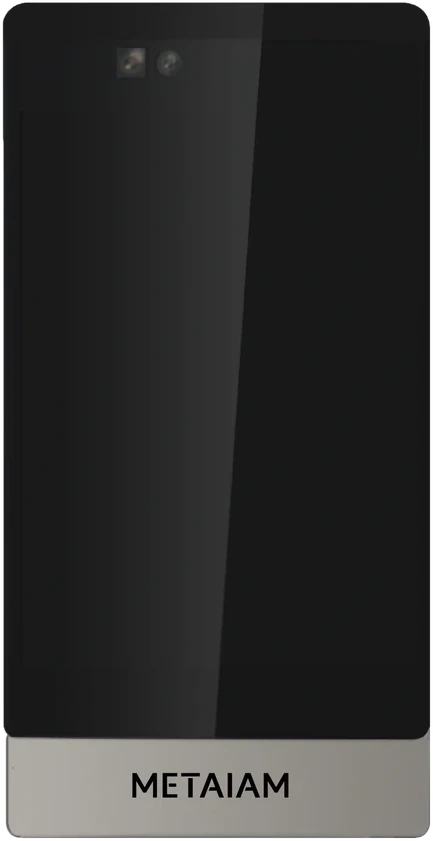
Move the trust decision from pixels to space. METAiD does not rely on a color image to establish presence — there is no RGB camera in the hardware to produce one.
A person is more than a face.
METAiD analyzes the physical structure of a person with depth sensing and spatial intelligence, at the point of verification.

Depth Structure
The person exists as a physical shape in space, not a flat image.
Spatial Consistency
Human geometry is evaluated as a whole physical structure.
Live Presence
Verification happens on the person physically at the sensing point.
No RGB Camera
By design. No color image, so no face photo to replay or steal.
Works with your
existing systems.
Access, business and security systems stay. METAiD adds proof of real physical presence.
- RequestA person requests access or an action at a controlled point.
- PolicyYour identity or authorization policy calls for physical verification.
- MeasureMETAiD measures the person in three dimensions and proves a real, enrolled person is at the reader.
- DecideYour system decides with presence proven, not appearance matched.
Harden the point, not the whole estate. Readers go on the openings and positions where impersonation would actually cost something. They run on existing wiring and power and output to the access control panels already installed, over Wiegand or OSDP.
What a deployment looks like.
Readers at the points worth hardening, with verification running on the device rather than in a service somewhere else.
What the verification
actually withstands.
Measured, not inferred
Depth is measured by the sensor. A model that infers depth from an image is producing a guess about a scene it was never in.
Presentation-attack resistance
Resists masks, replicas and 3D displays, not only single photographs.
Nothing to replay
There is no color image of the person anywhere in the system, so there is nothing to capture and present back to it.
Verified on the device
Verification runs on the node at the point of access, not on a stream sent somewhere to be judged.
Two people, not one
Require several authorized people present together, including a required combination of roles.
A record you can hand over
Every verification is recorded in IAMS and available to your own systems through the Enterprise API.
Why it holds up.
The authorized person.
The decision is made about the person at the reader, not about an image that reached the system.
Not forgeable.
AI can generate almost anything in the digital world. It cannot reconstruct the physical world a depth sensor measures.
Data that is safe to hold.
A strong liveness check still leaves the deeper problem untouched: the data. METAiD has no RGB camera, so no color photograph is produced. What is enrolled is not linked to a legal identity, and has no practical use anywhere else if it is taken.
Where it applies.
Points where being mistaken for someone else is worth the effort of faking it.
| Point of verification | The gap today | Industries |
|---|---|---|
| High-value service counters | Identity is confirmed from documents and appearance, both of which can now be produced convincingly. | |
| Sensitive checkpoints | A camera-based check at a controlled entrance decides from the same kind of image an attacker can supply. | |
| Operational control positions | An impersonated operator can do more damage in a minute than an intruder can in an hour. | |
| Cash and count areas | Staff verification has to be strong, while guests and patrons must not be identified at all. | |
| Restricted clinical areas | Verification has to be strong enough for controlled areas, and private enough for patients and staff. |
Built by a team with a track record of over 1 billion access events across more than 5,000 mission-critical sites. METAIAM is an OSPA finalist.
AI can generate an appearance.Physical presence requires a different proof.