
Time &
Attendance
Management
Attendance records that prove a real person was on site.
Time tracking should prove
the person was there.
Payroll is calculated from these records. Every one of them is produced by something a coworker can use on your behalf.
Badge / Card
Punches in whoever taps it.
PIN
A number the whole shift ends up knowing.
Mobile Check-In
Location can be spoofed, or checked from the parking lot.
Buddy Punching
One person clocks in or out for another.
Shared Credentials
Cards and PINs circulate around a team.
Off-Site Check-In
A shift starts before the worker arrives.
Turn the clock-in into a
verified presence event.
The difference shows up the moment someone asks a question of the record.
| The question | What a punch record answers | What a presence record answers |
|---|---|---|
| Who started this shift? | A credential assigned to that worker was used. | The enrolled worker was at the attendance point. |
| Were they on site? | Something was presented at a reader, or an app reported a location. | A real person was physically at the reader on site. |
| Is this payroll line correct? | It matches the punches, whoever made them. | It matches hours someone was actually there for. |
| The worker disputes it. | A manual correction, and a conversation. | The record stands on its own. |
Attendance becomes evidence of physical presence — not just evidence that a card, PIN or phone was used.
Reliable attendance starts
with a reliable event.
Use verified attendance events for payroll inputs, shift visibility, planning and exception handling.
- Main Entrance · Clock-inPresence verified
- Warehouse B · Clock-inPresence verified
- Clinic Floor 2 · Clock-inPresence verified
- Plant North · Clock-inPresence verified
Illustrative view.
Present / Absent
Know who actually arrived at the physical worksite.
On Time / Late
Exceptions based on verified event timing.
Multi-Site View
Attendance events across distributed locations, under one model.
Fewer Disputes
Records backed by a real on-site presence event mean fewer manual corrections.
Simple for employees.
Better data for operations.
Your time, attendance and HR systems stay. METAiD sends verified events into them.
- ArriveA scheduled worker arrives at the attendance point on site.
- ProveMETAiD proves the enrolled worker is physically at the reader.
- RecordA clock-in or clock-out event is created in real time.
- SyncThe verified event flows into your time and HR system, where schedules, shifts, overtime and payroll rules stay.
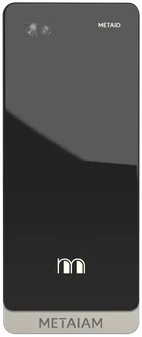
Replace the clock, keep the system. METAiD readers run on existing wiring and power and output to the panels already installed, over Wiegand or OSDP, with events reaching your time and HR system through the Enterprise API. Nothing about how payroll is calculated changes.
What a deployment looks like.
A reader at each attendance point, one platform across sites, and an API into the system that runs payroll.
Rules that hold without
a supervisor watching.
One person, one punch
The event belongs to the enrolled worker. There is no credential to hand to a coworker.
On site, not nearby
The event is created at a reader at the worksite, not by an app reporting a position.
Shift-bound access
Attendance and access can be tied to the shift, and end with it.
Contractors and temporary staff
Time-boxed enrollment for people who are only on site for a project, expiring on its own.
Nothing to replace
No cards to issue, reissue, or collect back when someone leaves.
Events in your systems
Every verification is available in real time through Webhooks, MQTT, WebSocket or REST.
Why it holds up.
The enrolled worker.
The hours belong to the person who was there, not to the credential that was presented.
Not forgeable.
A depth sensor measures physical space. A phone screen held up at the reader is a flat surface, not a body.
No photos of your workforce.
There is no RGB camera in the hardware, so no color photograph of an employee is ever produced. What is enrolled is not linked to a legal identity, and has no practical use anywhere else if it is taken — which matters when a workforce is being asked to clock in with something other than a card.
Where it applies.
Workforces where the hours on the record have to match the hours someone was actually there.
| Workforce scenario | The gap today | Industries |
|---|---|---|
| Shift change at scale | Dozens of people clock in within a few minutes. Nobody is checking whether each badge matches its holder. | |
| Distributed and unstaffed sites | No supervisor is present when the shift starts, so the credential is the only witness. | |
| Contractors and temporary staff | Billable hours are claimed against credentials issued for a short engagement and rarely returned. | |
| Regulated staffing levels | A roster shows who should have been on duty. Nothing shows who was. | |
| Payroll disputes and corrections | Disputed punches are settled by manual adjustment, which costs administrative time every cycle. |
Built by a team with a track record of over 1 billion access events across more than 5,000 mission-critical sites. METAIAM is an OSPA finalist.
A time record should prove more than a punch.It should prove the person was there.